When calcium leaves its mark: a case of calciphylaxis in peritoneal dialysis. A multidisciplinary approach to the treatment of calciphylaxis
DOI:
https://doi.org/10.32818/reccmi.a11n1a2Keywords:
calciphylaxis, peritoneal dialysis, chronic kidney disease-mineral and bone disorder (CKD-MBD), skin ulcerAbstract
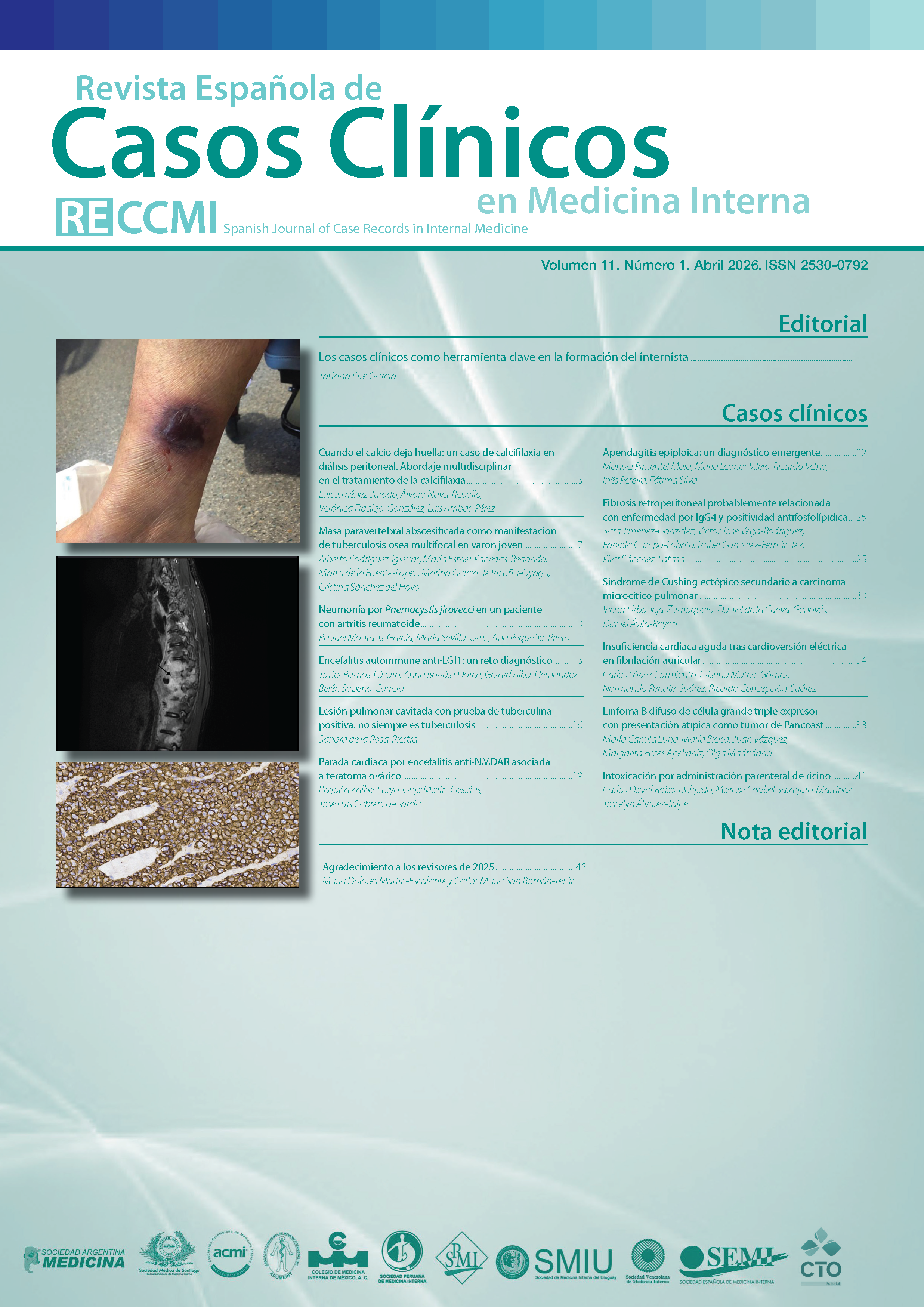
An 80-year-old woman with stage 5 chronic kidney disease secondary to autosomal dominant polycystic kidney disease, and on automated peritoneal dialysis, developed cutaneous calciphylaxis, an uncommon complication with high morbidity and mortality in patients on renal replacement therapy. She was admitted with pain and cellulitis in her right leg, which progressed to a painful ulcer. Calciphylaxis was confirmed by skin biopsy. A combination of renal replacement therapy was chosen, maintaining peritoneal dialysis and temporarily intensifying hemodialysis to optimize metabolic control, along with the administration of intravenous sodium thiosulfate. The multidisciplinary approach, involving Internal Medicine, Nephrology, and Dermatology, was crucial in controlling calcium-phosphorus metabolism, managing pain, preventing infections, and restoring the skin lesions. Clinical improvement following intensified dialysis and sodium thiosulfate therapy allowed for a gradual reduction in hemodialysis intensity, while maintaining peritoneal dialysis as the primary technique. This case highlights the importance of individualized and multidisciplinary management of calciphylaxis and suggests that, in selected patients, the temporary combination of renal replacement therapy techniques is effective in optimizing metabolic control and preserving quality of life.
The patient was admitted with pain and cellulitis in her right leg, which progressed to a painful ulcer. After confirming calciphylaxis through biopsy, treatment included intensified hemodialysis and intravenous sodium thiosulfate administration. Despite initial complications such as nausea and vomiting, premedication adjustments allowed better treatment tolerance.
A multidisciplinary approach was crucial, improving calcium-phosphorus metabolism control and the progression of skin lesions. Sodium thiosulfate therapy proved effective, reducing the need for hemodialysis and stabilizing the patient.
In summary, this case highlights the importance of sodium thiosulfate treatment and interdisciplinary collaboration in managing calciphylaxis complications, significantly improving the patient's quality of life.
Downloads
Metrics
References
Brandenburg VM, Cozzolino M, Ketteler M. Calciphylaxis: a still unmet challenge. J Nephrol. 2011; 24(2): 142-48. doi: https://doi.org/10.5301/jn.2011.6366 (último acceso mar. 2026). DOI: https://doi.org/10.5301/JN.2011.6366
Nigwekar SU, Thadhani R, Brandenburg VM. Calcifilaxis. N Engl J Med. 2018; 378(18): 1704-14. doi: https://doi.org/10.1056/NEJMra1505292 (último acceso mar. 2026). DOI: https://doi.org/10.1056/NEJMra1505292
Nigwekar SU, Brunelli SM, Meade D, Wang W, Hymes J, Lacson E Jr. Sodium thiosulfate therapy for calcific uremic arteriolopathy. Clin J Am Soc Nephrol. 2013; 8(7): 1162-70. doi: https://doi.org/10.2215/CJN.09880912 (último acceso mar. 2026). DOI: https://doi.org/10.2215/CJN.09880912
Salmhofer H, Franzen M, Hitzl W, Koller J, Kreymann B, Fend F, et al. Multi-modal treatment of calciphylaxis with sodium-thiosulfate, cinacalcet and sevelamer including long-term data. Kidney Blood Press Res. 2013; 37(4-5): 346-59. doi: https://doi.org/10.1159/000350162 (último acceso mar. 2026). DOI: https://doi.org/10.1159/000350162
Shroff R, Long DA, Shanahan C. Mechanistic insights into vascular calcification in CKD). J Am Soc Nephrol. 2013; 24(2): 179-89. doi: https://doi.org/10.1681/ASN.2011121191 (último acceso mar. 2026). DOI: https://doi.org/10.1681/ASN.2011121191
Chertow GM, Block GA, Correa-Rotter R, Drüeke TB, Floege J, Goodman WG, et al. EVOLVE trial investigators. Effect of cinacalcet on cardiovascular disease in patients undergoing dialysis. N Engl J Med. 2012; 367(26): 2482-94. doi: https://doi.org/10.1056/NEJMoa1205624 (último acceso mar. 2026). DOI: https://doi.org/10.1056/NEJMoa1205624
Weenig RH, Sewell LD, Davis MD, McCarthy JT, Pittelkow MR. Calciphylaxis: natural history, risk factor analysis, and outcome. J Am Acad Dermatol. 2007; 56(4): 569-79. doi: https://doi.org/10.1016/j.jaad.2006.08.065 (último acceso mar. 2026). DOI: https://doi.org/10.1016/j.jaad.2006.08.065
Udomkarnjananun S, Kongnatthasate K, Praditpornsilpa K, Eiam-Ong S, Jaber BL, Susantitaphong P. Treatment of calciphylaxis in CKD: a systematic review and meta-analysis. Kidney Int Rep. 2018; 4(2): 231-44. doi: https://doi.org/10.1016/j.ekir.2018.10.002 (último acceso mar. 2026). DOI: https://doi.org/10.1016/j.ekir.2018.10.002
Downloads
Published
How to Cite
Issue
Section
License
Copyright (c) 2026 Luis Jiménez-Jurado, Álvaro Nava-Rebollo, Verónica Fidalgo-González , Luis Arribas-Pérez

This work is licensed under a Creative Commons Attribution-NonCommercial-NoDerivatives 4.0 International License.
Permite compartir, copiar y redistribuir el material en cualquier medio o formato, bajo los siguientes términos:
Reconocimiento: debe otorgar el crédito correspondiente, proporcionar un enlace a la licencia e indicar si se realizaron cambios. Puede hacerlo de cualquier manera razonable, pero no de ninguna manera que sugiera que el licenciante lo respalda a usted o su uso.
No comercial: no puede utilizar el material con fines comerciales.
No Derivados: si remezcla, transforma o construye sobre el material, no puede distribuir el material modificado.
Sin restricciones adicionales: no puede aplicar términos legales o medidas tecnológicas que restrinjan legalmente a otros de hacer cualquier cosa que permita la licencia.