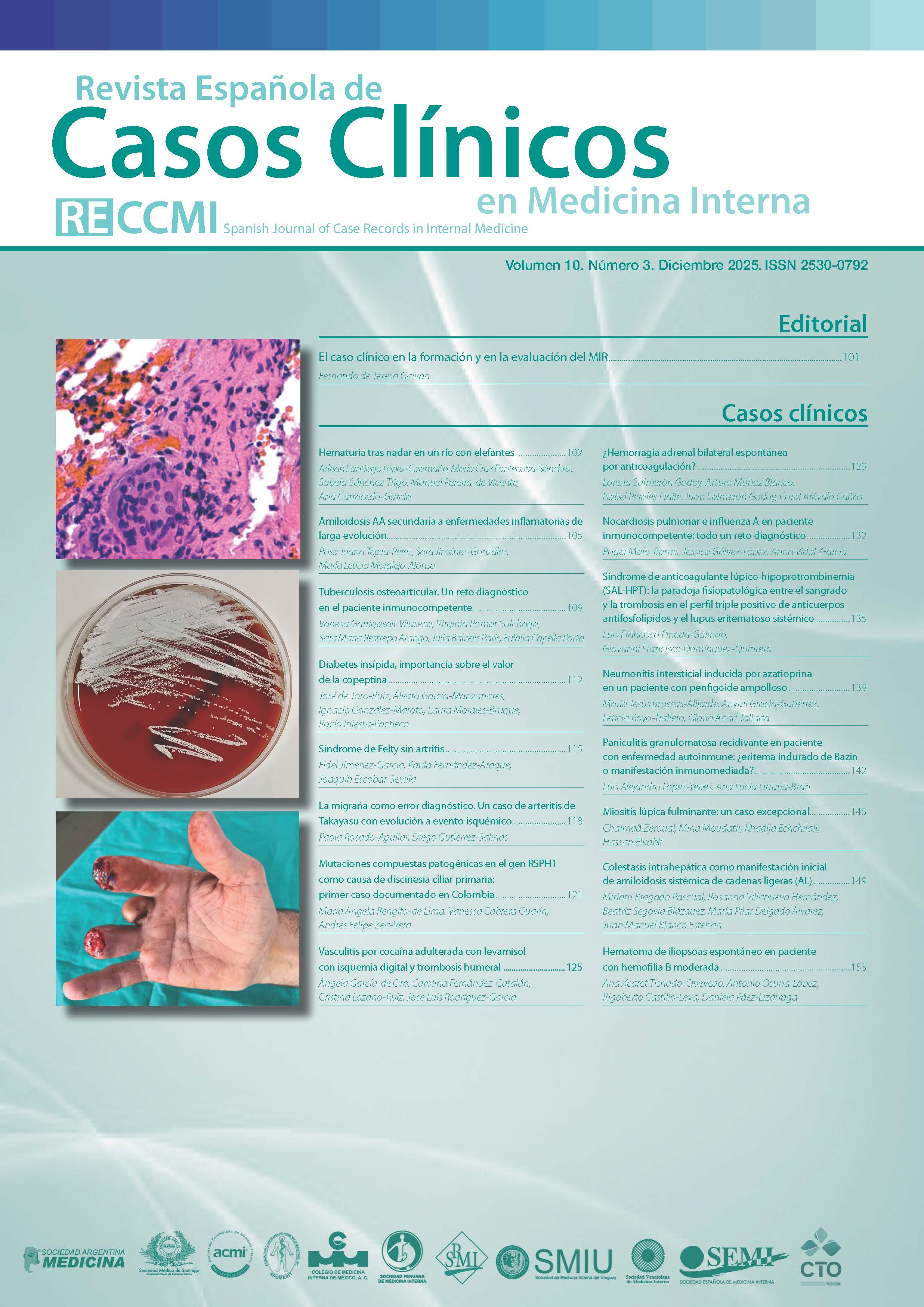
Síndrome de anticoagulante lúpico-hipoprotrombinemia (SAL-HPT): la paradoja fisiopatológica entre el sangrado y la trombosis en el perfil triple positivo de anticuerpos antifosfolípidos y el lupus eritematoso sistémico
DOI:
https://doi.org/10.32818/reccmi.a10n3a12Palabras clave:
síndrome antifosfolípido, inhibidor de la coagulación lúpica, lupus eritematoso sistémico, hipoprotrombinemias, deficiencia del factor IIResumen
El síndrome de anticoagulante lúpico-hipoprotrombinemia (SAL-HPT) es una entidad rara asociada a enfermedades autoinmunes y puede presentarse como hemorragia sin disminución del riesgo de trombosis. Presentamos el caso de un hombre joven con hemorragia como manifestación inicial asociado a lupus eritematoso sistémico (LES) y perfil de anticuerpos antifosfolípidos triple positivo con riesgo alto de trombosis. Discutimos aquí sobre el manejo médico ante el sangrado y el riesgo de trombosis, la actividad inmunológica y los mecanismos causantes de las alteraciones en los tiempos y la actividad de factores de la coagulación.
Descargas
Métricas
Citas
Omer MH, Salama H, Alghaythi AM, Alharbi AA, AlJohani G. Lupus anticoagulant-hypoprothrombinemia syndrome and pseudotumor cerebri as an initial presentation of systemic lupus erythematosus in a 16-year-old male patient: a case report and literature review. American Journal of Case Reports. 2022; 23. doi: http://dx.doi.org/10.12659/AJCR.938051 (último acceso dic. 2025). DOI: https://doi.org/10.12659/AJCR.938051
Mazodier K, Arnaud L, Mathian A, Costedoat-Chalumeau A, Haroche J, Frances C, et al. Lupus anticoagulant-hypoprothrom- binemia syndrome: report of 8 cases and review of the literature. Medicine (Baltimore). 2012;91(5): 251-60. DOI: https://doi.org/10.1097/MD.0b013e31826b971f (último acceso dic. 2025). DOI: https://doi.org/10.1097/MD.0b013e31826b971f
Pazzola G, Zuily S, Erkan D. The challenge of bleeding in antiphospholipid antibody-positive patients. Current Rheumatology Reports. 2015; 17(2). doi: https://doi.org/10.1007/s11926-014-0481-0 (último acceso dic. 2025). DOI: https://doi.org/10.1007/s11926-014-0481-0
Mulliez S, F De Keyser, C Verbist, Vantilborgh A, Wijns W, Beukinga I, et al. Lupus anticoagulant-hypoprothrombinemia syndrome: report of two cases and review of the literature. Lupus. 2015; 24(7): 736–45. doi: https://doi.org/10.1177/0961203314558859 (último acceso dic. 2025). DOI: https://doi.org/10.1177/0961203314558859
Ahmed AEE. Autoantibodies to coagulation factors and bleeding disorders. Clinical Reviews in Allergy & Immunology. 1998; 16(3): 313–19. doi: https://doi.org/10.1007/BF02737641 (último acceso dic. 2025). DOI: https://doi.org/10.1007/BF02737641
Forastiero R. Bleeding in the antiphospholipid syndrome. Hematology (Amsterdam, Netherlands). 2012; 17 Suppl 1: S153-55. doi: https://doi.org/10.1179/102453312X13336169156654 (último acceso dic. 2025). DOI: https://doi.org/10.1179/102453312X13336169156654
Carvalho C, Viveiro C, Maia P, Rezende T. Acquired antiprothrombin antibodies: an unusual cause of bleeding. Case Reports. 2013; 2013 (jan07 1): bcr2012007948–8. doi: https://doi.org/10.1136/bcr-2012-007948 (último acceso dic. 2025). DOI: https://doi.org/10.1136/bcr-2012-007948
Meireles E, Machado F, Teles L, Chumakova A, Sequeira J, Spínola A. A case report of severe bleeding due to lupus anticoagulant hypoprothrombinemia syndrome. Journal of Thrombosis and Thrombolysis. 2019; 49(2): 334–36. doi: https://doi.org/10.1007/s11239-019-01955-1 (último acceso dic. 2025). DOI: https://doi.org/10.1007/s11239-019-01955-1
Descargas
Publicado
Cómo citar
Número
Sección
Licencia
Derechos de autor 2025 Luis Francisco Pineda-Galindo, Giovanni Francisco Domínguez-Quintero

Esta obra está bajo una licencia internacional Creative Commons Atribución-NoComercial-SinDerivadas 4.0.
Permite compartir, copiar y redistribuir el material en cualquier medio o formato, bajo los siguientes términos:
Reconocimiento: debe otorgar el crédito correspondiente, proporcionar un enlace a la licencia e indicar si se realizaron cambios. Puede hacerlo de cualquier manera razonable, pero no de ninguna manera que sugiera que el licenciante lo respalda a usted o su uso.
No comercial: no puede utilizar el material con fines comerciales.
No Derivados: si remezcla, transforma o construye sobre el material, no puede distribuir el material modificado.
Sin restricciones adicionales: no puede aplicar términos legales o medidas tecnológicas que restrinjan legalmente a otros de hacer cualquier cosa que permita la licencia.